



$XRP holders are underwater by more, on average, than they have ever been, according to onchain data that some traders treat as a contrarian floor signal.
The reading comes from MVRV, or market value to realized value, a ratio that compares $XRP's price with the average price at which its supply last moved.
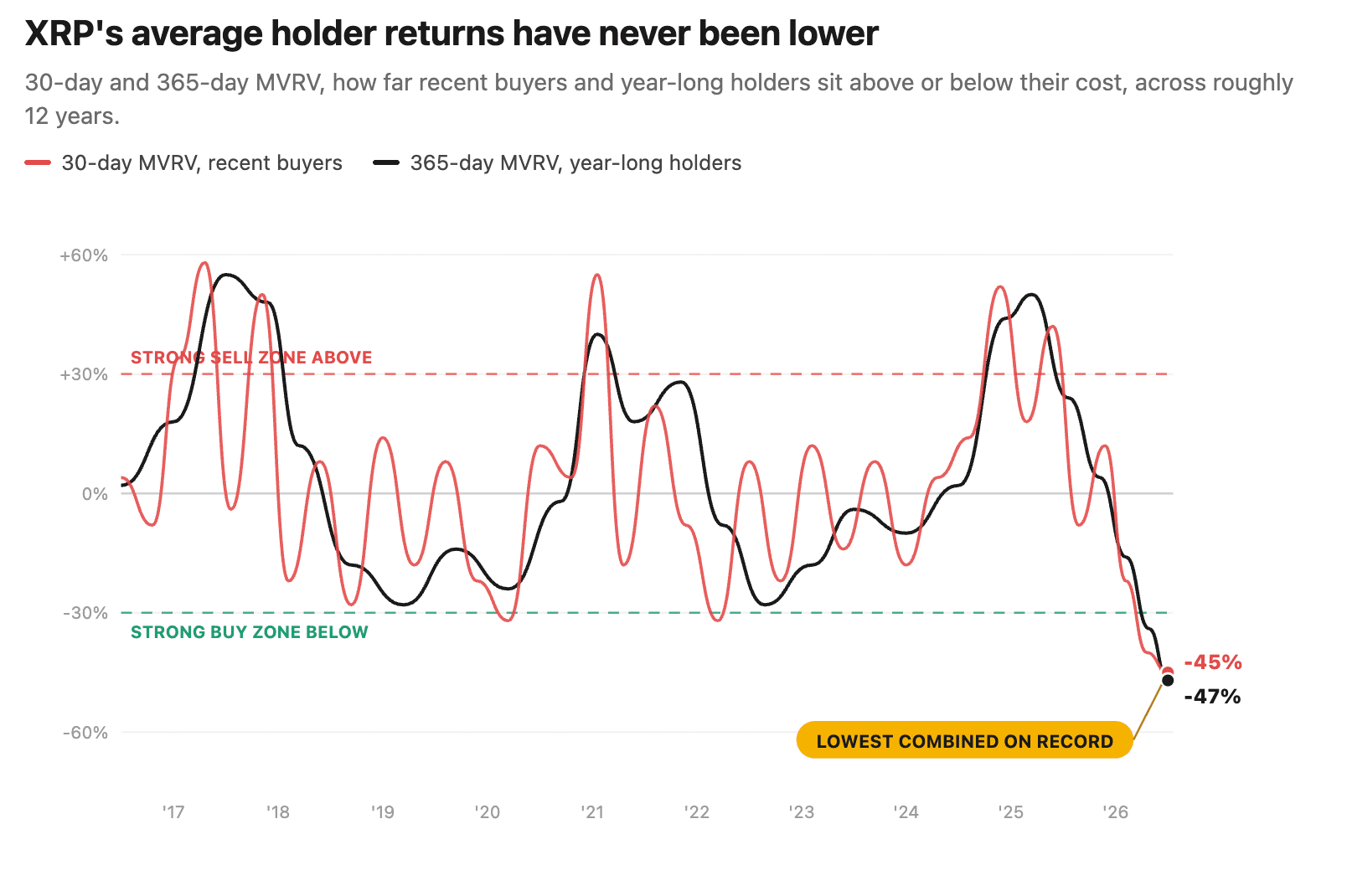
When it sits below zero, the typical holder is carrying a loss. $XRP's 30-day MVRV is around -45% and its 365-day version around -47%, so both recent buyers and those who have held for a year are deep in the red.
Combined, the two are at their lowest in $XRP's history, analytics firm Santiment said in a Friday post.
That describes a capitulation, the phase where holders sit on steep unrealized losses and weaker hands sell out to those willing to absorb the coins. Santiment is careful to call this a risk-reward point, instead of a price call.
"The best setups often appear when the crowd is feeling maximum pain," the firm wrote, stating that so much downside has already been taken on that adding here carries less risk than usual, while noting price can still fall further if the broader market weakens.
$XRP has climbed even as that reading stays depressed. The token is up about 8% over seven days to around $1.14, per CoinDesk data, among the week's stronger majors.
It fits a pattern onchain analysts have flagged lately, with large bitcoin wallets accumulating through record ETF outflows, the capitulation-and-absorption setup that tends to form near cycle lows rather than tops.
None of that signals a confirmed bottom, however. MVRV measures how washed out positioning is, not when it turns, and stretched losses can stay stretched while a market grinds sideways or lower.
What the gauge shows is that the selling pressure from underwater holders is largely spent, and traders should keep track of whether buyers continue to step
