


Bitcoin returns far less for every dollar of new money entering it than it did in its early years, a decline in capital efficiency that has grown sharper as the asset has scaled.
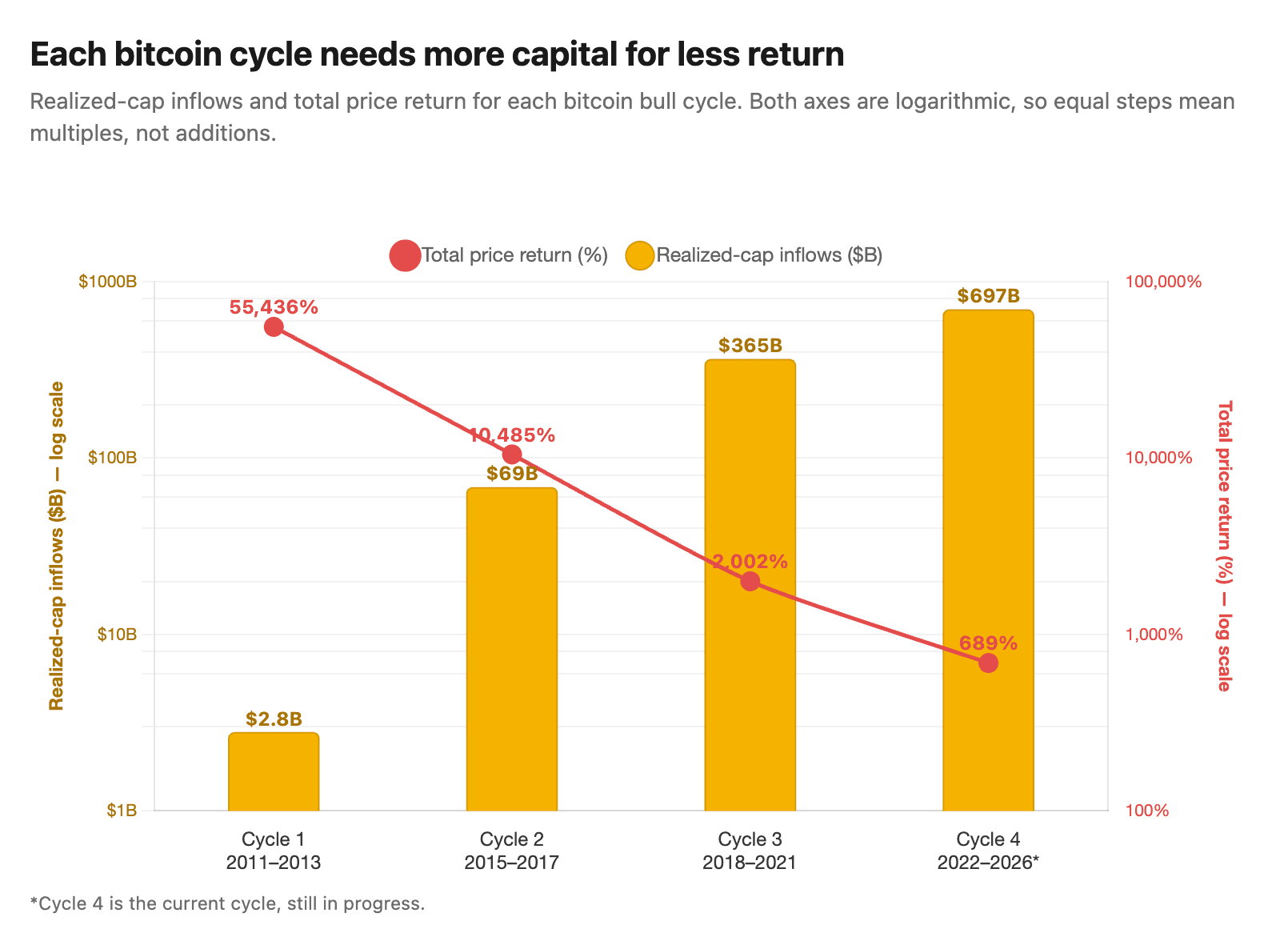
Analytics firm CryptoQuant measured how much fresh capital each bitcoin bull cycle took in against the price gain it produced. In the 2011 cycle, about $2.8 billion in net inflows drove a rally of roughly 55,000%.
The 2015 cycle took about $69 billion for a gain near 10,000%. The 2018 cycle needed about $365 billion for roughly 2,000%. This cycle, running since 2022, has taken in about $697 billion and returned 689%. The figures track realized capitalization, a measure that values each coin at the price it last moved rather than its current price, a rough gauge of how much money has actually gone into the asset.
The trend holds at every scale. In 2011, roughly $5 million in new money was enough to double bitcoin's price. This cycle, doing the same took around $101 billion. Each run has demanded exponentially more capital for a smaller percentage move, the arithmetic of an asset that now carries a market value near $1.2 trillion, per CoinDesk data, rather than the few billion it held a decade ago.
CryptoQuant founder Ki Young Ju, who published the data, called it as a case for patience rather than a top. "Bitcoin needs to be a core macro asset, not just a retail-driven ETF trade," he wrote, arguing that another parabolic run is possible only if bitcoin can absorb more than $1 trillion in fresh capital, which would take institutional adoption well beyond where it sits today.
That argument lands at an awkward moment. U.S. spot bitcoin exchange-traded funds have seen record outflows over the past month, and bitcoin closed a losing first half, so the retail flows the thesis wants to move past are running in reverse rather than building the institutional depth it calls for.
