
Polygon price continued its steady downtrend this week, even as the network’s activity surged after the Madhugiri hard fork.
- Polygon price has slumped to the lowest point this year.
- The network activated the Madhugiri hard fork this week.
- The number of transactions in the network has soared.
Polygon (POL) token slumped to a new fresh low after it transitioned to POL from MATIC last year. It was trading at $0.1200, down by double-digits from the September high of $0.2970.
The ongoing Polygon price crash is happening despite the network having some of the best fundamentals. For example, the number of transactions has gone parabolic after the developers activated the Madhugiri hard fork, which introduced new features.
It boosted the transaction speeds by 33%, introduced 1-second block consensus, and the supported of the recently launched Ethereum Fusaka upgrade.
Data shows that Polygon handled over 8.1 million transactions within a single day after this upgrade happened. More numbers by Nansen show that the network’s transactions have risen by 93% in the last 30 days to over 158 million. This growth makes it the second-fastest-growing chain in crypto after Monad.
? @0xPolygon keeps the momentum rolling
— Chainspect (@chainspect_app) December 12, 2025
Post-Madhugiri, Polygon just processed 8.1M+ transactions in a single day, its strongest activity in the last three months
This is what real-world scale looks like ?
? https://t.co/ycircbywyu pic.twitter.com/TC8pbaUQET
More data reveals that the number of active addresses on Polygon has jumped by 54% in the last 30 days to 13 million. As a result, the amount of fees collected jumped by 27% to $778,000. This is important as Polygon constantly burns its fees, a move that helps to offset new POL issuance.
Polymarket has played a role in boosting the Polygon ecosystem. Data shows that the network had a volume of $4.3 billion in November, a figure that will keep growing now that it has expanded in the United States. Polymarket runs on Polygon’s network.
November went parabolic.
— Polygon | POL (@0xPolygon) December 11, 2025
$4.33B in prediction volume on Polygon. @Polymarket’s biggest month ever.
Onchain markets stay winning. pic.twitter.com/S93RBsbIhY
The ongoing Polygon price crash has led to concerns that it has become highly undervalued. A popular analyst compared its market cap with that of Sui (SUI).
Polygon has a DeFi TVL of over $1.19 billion compared to Sui’s $931 million. It also has over $2.825 billion in stablecoin supply compared to Sui’s $0.5 million. Polygon also makes more money, has fewer unlocks, and yet it is 5x smaller than Sui.
SUI falls behind Polygon on almost every metric, has massive monthly unlocks and inflation – yet it has 5× the Market Cap and 15× the FDV.
— Vadim (@crypto_vadim) December 12, 2025
What’s going on with these valuations?
Let’s break it down:
Network revenue in November: 928K vs 724K
TVL: 1.19B vs 931M
Stablecoin market… pic.twitter.com/UY2DkomPLM
Polygon price technical analysis
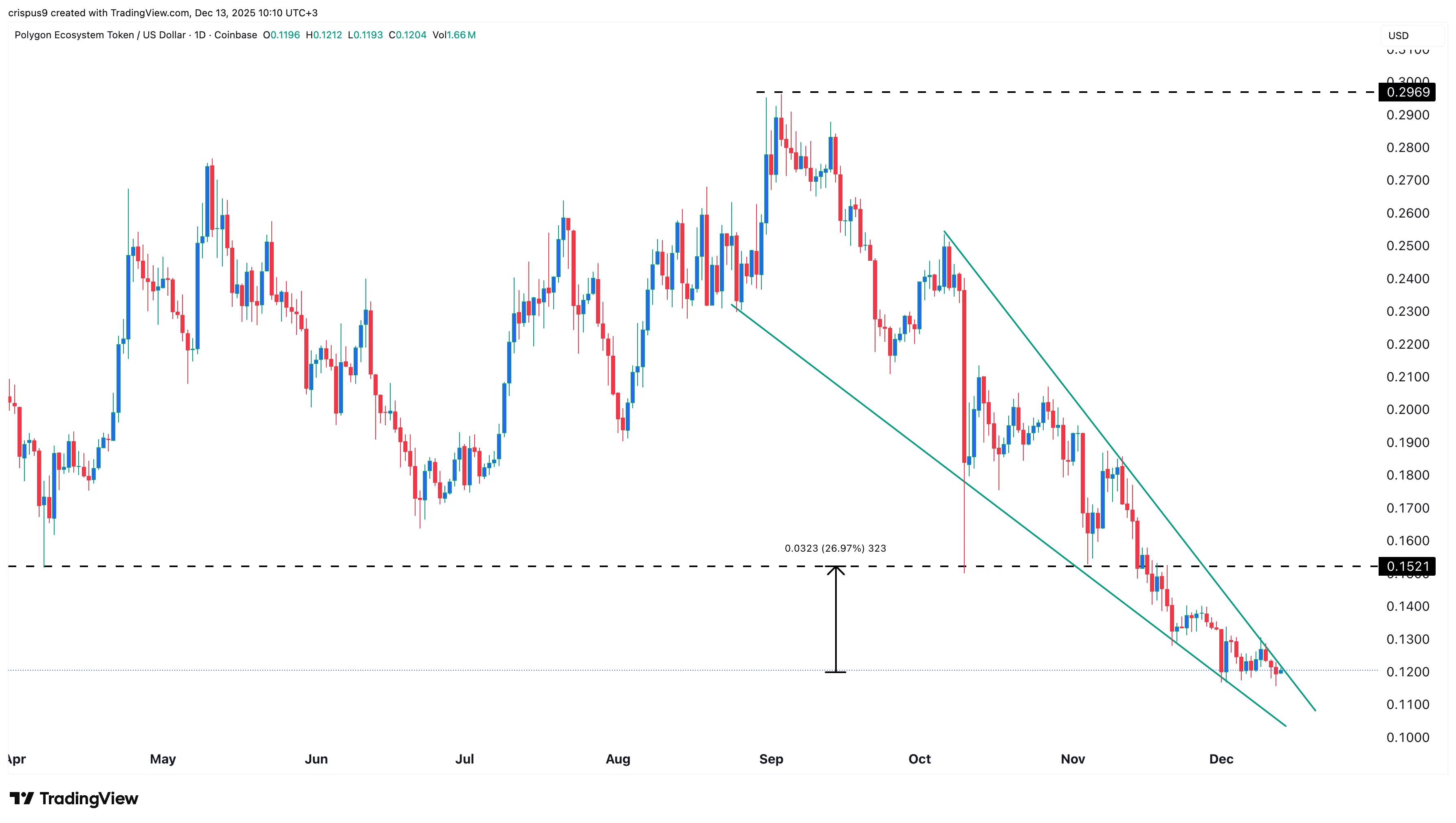
The daily chart shows that the POL price has been in a steady freefall in the past few months. It has tumbled from a high of $0.2970 in September to $0.12 today. As a result, it has moved below the key support level at $0.1520, a point it failed to move below several times.
Polygon price remains below all moving averages, while top oscillators have continued falling. On the positive side, the token has formed a falling wedge pattern whose two lines are about to converge.
The wedge pattern means that the POL price may rebound soon. Such a rebound may see it rise to the key resistance level at $0.1520, which is nearly 30% above the current level.
